The EU AI Act has been in force since 1 August 2024. Prohibited practices and the AI literacy duty apply since 2 February 2025, and obligations for general-purpose AI models since 2 August 2025. Many organisations still do not know whether they are a provider or a deployer, or which of their systems are high-risk.
Obligations depend on the role and the use case, not on the tool. The same model can be minimal risk in one department and high-risk in HR. A policy document alone does not show an authority what you decided for each system and why.
What we do
EU AI Act Compliance
Determine your role
For each AI system we establish whether you act as provider or deployer, including cases where your own changes or branding may make you the provider.
Rule out prohibited practices
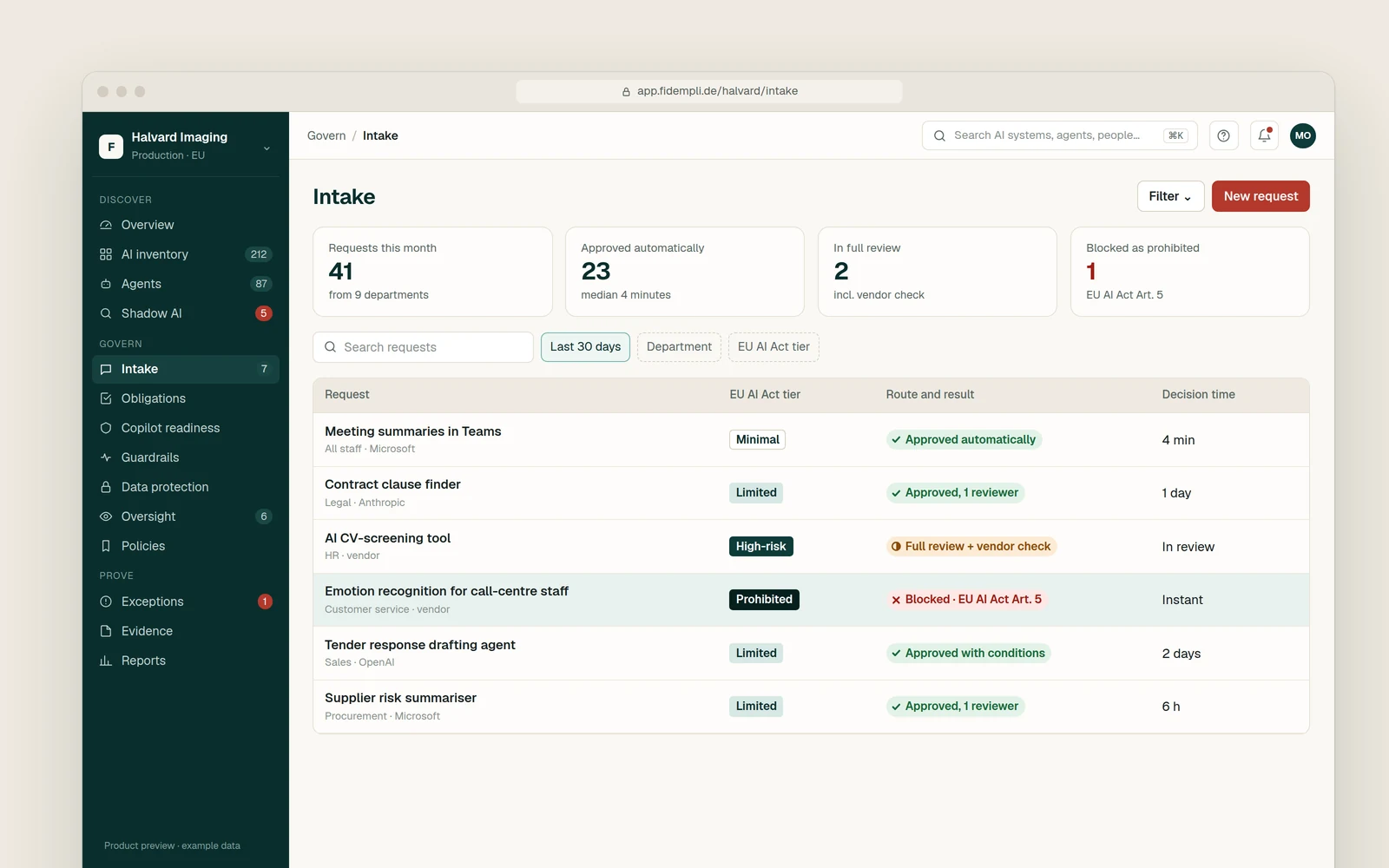
We check every use case against Article 5, such as social scoring, emotion recognition at work and manipulative techniques, and stop what is not allowed.
Classify high-risk and transparency cases
We assess each system against Article 6 and Annex III, and identify where transparency obligations apply, for example chatbots or AI-generated content. The reasoning is recorded.
Implement the obligations
We set up what each role requires: for deployers human oversight, logs and informing workers; for providers risk management, technical documentation under Article 11 and Annex IV, and quality management.
Build AI literacy
We define the AI literacy your staff need under Article 4, by role, and set up training and records that show who completed what.
Govern new AI uses
We introduce an intake and approval process, roles and policies, so that every new AI use is classified before it goes live.
How we deliver
Consulting · Professional services · Managed services
Consulting
Our consultants classify your AI systems, interpret the obligations for your role and design the governance model with your legal, compliance and IT teams.
Professional services
Our team implements intake, oversight, logging and documentation in your environment, including Microsoft 365 and the AI platforms you use.
Managed services
We keep classifications, obligations and evidence current as a managed service, and review new AI uses as they come in.
AI automation in this service
Automated EU AI Act pre-classification of each AI use case from the intake form, reviewed by a consultant
Automated drafting of technical documentation and records from inventory and intake data, for a person to complete and approve
Automated tracking of AI literacy training completion per user, compared with the list of people who use AI tools
What you get
Register of AI systems with role, risk category and reasoning
Obligations per AI system, with owner and status
AI policy, intake and approval process
AI literacy concept and training records
Documentation set and evidence pack for authority requests
Frameworks
EU AI Act
GDPR
ISO/IEC 42001
In detail
Topics covered
Role: provider or deployer
Prohibited practices (Art. 5)
High-risk classification (Art. 6, Annex III)
Deployer obligations (Art. 26)
Technical documentation (Art. 11, Annex IV)
Transparency obligations (Art. 50)
AI literacy (Art. 4)
General-purpose AI models
Platform
After the project, the Fidempli platform keeps it running
From December 2026 the Fidempli platform carries this forward: new AI uses are classified at intake, prohibited practices cannot be approved, and each obligation keeps its owner and evidence.
Does the EU AI Act apply to us if we only use AI, not build it?
Yes. As a deployer you have your own obligations, such as AI literacy, and for high-risk systems human oversight, monitoring and keeping logs. We establish your role for each system.
When do the high-risk obligations apply?
The timeline for high-risk obligations is subject to changes at EU level. We track the current status and plan with you, so the work done now counts either way. Prohibited practices and AI literacy already apply.
We use Microsoft 365 Copilot and ChatGPT. Are they high-risk?
Usually not as general assistants. The risk category depends on the use case: the same tool used to screen job applicants can fall under Annex III. We classify by use, not by product.
What does AI literacy under Article 4 require?
Providers and deployers must take measures so that staff working with AI have sufficient AI literacy for their role and context. We define what that means for each group and how you record it.
How does this relate to GDPR and ISO/IEC 42001?
GDPR applies alongside the AI Act whenever personal data is involved. ISO/IEC 42001 gives you a management system to run AI governance. We align the work so that one set of records serves all three.