Many organisations in Germany must designate a data protection officer: under Article 37 GDPR, and under § 38 BDSG as a rule when at least 20 people are regularly involved in the automated processing of personal data, or regardless of headcount when processing requires a data protection impact assessment.
An internal DPO needs expert knowledge, time and independence, and must not have a conflict of interest, which rules out many IT and management roles. New topics such as AI tools, agents and international transfers add to the workload.
What we do
External Data Protection Officer
Check the obligation and onboard
We confirm whether you must designate a DPO, agree the scope in a service contract under Article 37(6) GDPR and help you publish the contact details and notify the supervisory authority.
Baseline audit
We review your records of processing, notices, processor contracts, security measures and open issues, and agree priorities with management.
Advise and monitor
We advise management and staff on their obligations, monitor compliance and give our opinion on data protection impact assessments, as Article 39 GDPR requires.
Point of contact
We act as contact point for data subjects and the supervisory authority and support you with rights requests and data breaches.
Train and raise awareness
We train staff on data protection, including the use of AI tools, and keep guidance current.
Report to management
We report regularly to the highest level of management on the state of data protection, risks and recommended actions.
How we deliver
Consulting · Professional services · Managed services
Automated tracking of data subject requests, breaches and DPIAs with their deadlines.
Automated drafts of records of processing entries and DPIA screenings for the DPO to review.
Automated monitoring of new AI tools in use, flagged for a data protection review.
What you get
Designation of the external DPO and notification of the supervisory authority
Baseline data protection audit with priorities
Opinions on data protection impact assessments
Handling of requests from data subjects and the authority
Training sessions and guidance
Regular data protection reports to management
Frameworks
GDPR
BDSG
TDDDG
EU AI Act
In detail
When a DPO is required
Public authorities and bodies (Art. 37(1)(a) GDPR)
Large-scale regular and systematic monitoring (Art. 37(1)(b))
Large-scale processing of special categories (Art. 37(1)(c))
As a rule, at least 20 people regularly involved in automated processing (§ 38 BDSG)
Processing that requires a DPIA (§ 38 BDSG)
Tasks of the DPO (Art. 39 GDPR)
Inform and advise
Monitor compliance, including training and audits
Advise on DPIAs
Cooperate with the supervisory authority
Act as contact point
Platform
After the project, the Fidempli platform keeps it running
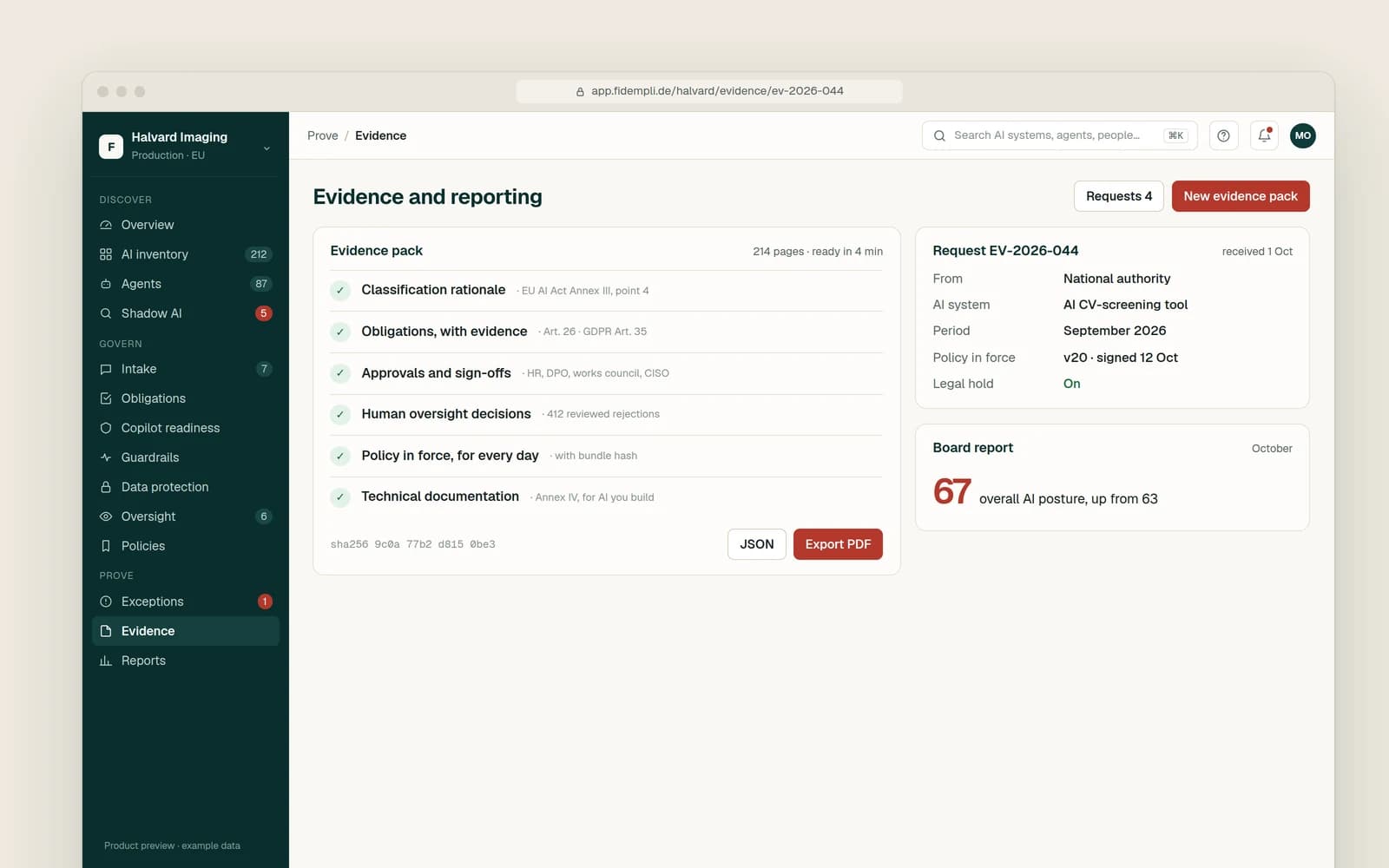
From December 2026, the Fidempli platform gives your DPO a live view of AI in use: each AI system with its owner, data categories and DPIA, and alerts when a new tool appears.
In Germany, as a rule, if at least 20 people are regularly involved in automated processing of personal data, if you carry out processing that requires a DPIA, or if Article 37 GDPR applies. We check your situation before you decide.
Why external rather than internal?
An external DPO brings expert knowledge from the start, is independent of your internal roles and avoids conflicts of interest. You also avoid the special protection against dismissal that applies to internal DPOs in Germany.
Does the DPO take responsibility for compliance?
No. Responsibility stays with your organisation as controller. The DPO advises, monitors and reports, and must be able to do so independently.
How much of our time does it take?
After the baseline audit, typically a regular meeting with your contact person, a periodic report to management and ad hoc questions. We agree the rhythm in the contract.
Do you cover AI questions?
Yes. AI tools, agents and providers are a growing part of the DPO's work. We combine data protection with our AI governance and security experience.