

The Fidempli AI governance platform launches in December 2026. Design-partner places are open.Apply now →
Fidempli

Data Protection & Privacy

Data discovery and classification.

You know where personal and confidential data sits, and it carries labels that tools and AI respect.

The problem

Personal and confidential data spreads across mailboxes, SharePoint sites, Teams chats, file shares and cloud storage. Without knowing where it is, you cannot answer access requests completely, apply retention or show that security measures fit the risk.

AI makes the gap visible. Microsoft 365 Copilot and other assistants can surface anything a user has access to, so overshared files and unlabelled data turn into answers in a chat. Labels and data loss prevention only help once the data has been found and classified.

What we do

Data Discovery & Classification

  1. Define the classification scheme

    We agree a small set of sensitivity levels with your business, privacy and security owners, and what each level means for access, sharing, encryption and retention.

  2. Discover the data

    We scan your Microsoft 365 and cloud storage for personal, health, financial and confidential data using built-in and custom sensitive information types and classifiers.

  3. Label and protect

    We configure sensitivity labels, default and automatic labelling, and the protection each label applies, then roll them out with your users.

  4. Prevent data loss

    We set data loss prevention policies for email, SharePoint, OneDrive, Teams and endpoints, start in audit mode and tighten them with the business.

  5. Fix oversharing before AI

    We find sites and files shared too widely, clean up permissions and check which sensitive data Copilot and other AI tools can reach.

  6. Keep it current

    We monitor label and DLP activity, tune false positives, apply retention and report on where sensitive data sits.

AI automation in this service

  • Automated scanning for personal, health and financial data with sensitive information types and trainable classifiers.
  • Automated labelling suggestions and auto-labelling policies, reviewed before they are enforced.
  • Automated reports on oversharing and on which sensitive files AI assistants can reach.

What you get

  • Classification scheme and labelling guideline
  • Data discovery report: where personal and confidential data sits
  • Configured sensitivity labels and auto-labelling
  • Data loss prevention and retention policies
  • Oversharing clean-up plan and results
  • Monitoring and reporting set-up

Frameworks

  • GDPR
  • ISO/IEC 27001
  • NIS2
  • EU AI Act

In detail

Microsoft Purview

  • Sensitivity labels and auto-labelling
  • Sensitive information types and trainable classifiers
  • Data loss prevention
  • Retention labels and policies
  • Content and activity explorer
  • Data security posture for AI

Data sources

  • Exchange Online
  • SharePoint and OneDrive
  • Microsoft Teams
  • Windows and macOS endpoints
  • Azure and other cloud storage
  • File shares

Platform

After the project, the Fidempli platform keeps it running

From December 2026, the Fidempli platform uses your labels at the point of use: prompts with personal or confidential data are blocked, redacted or allowed by policy before they reach an AI model.

Explore the platform
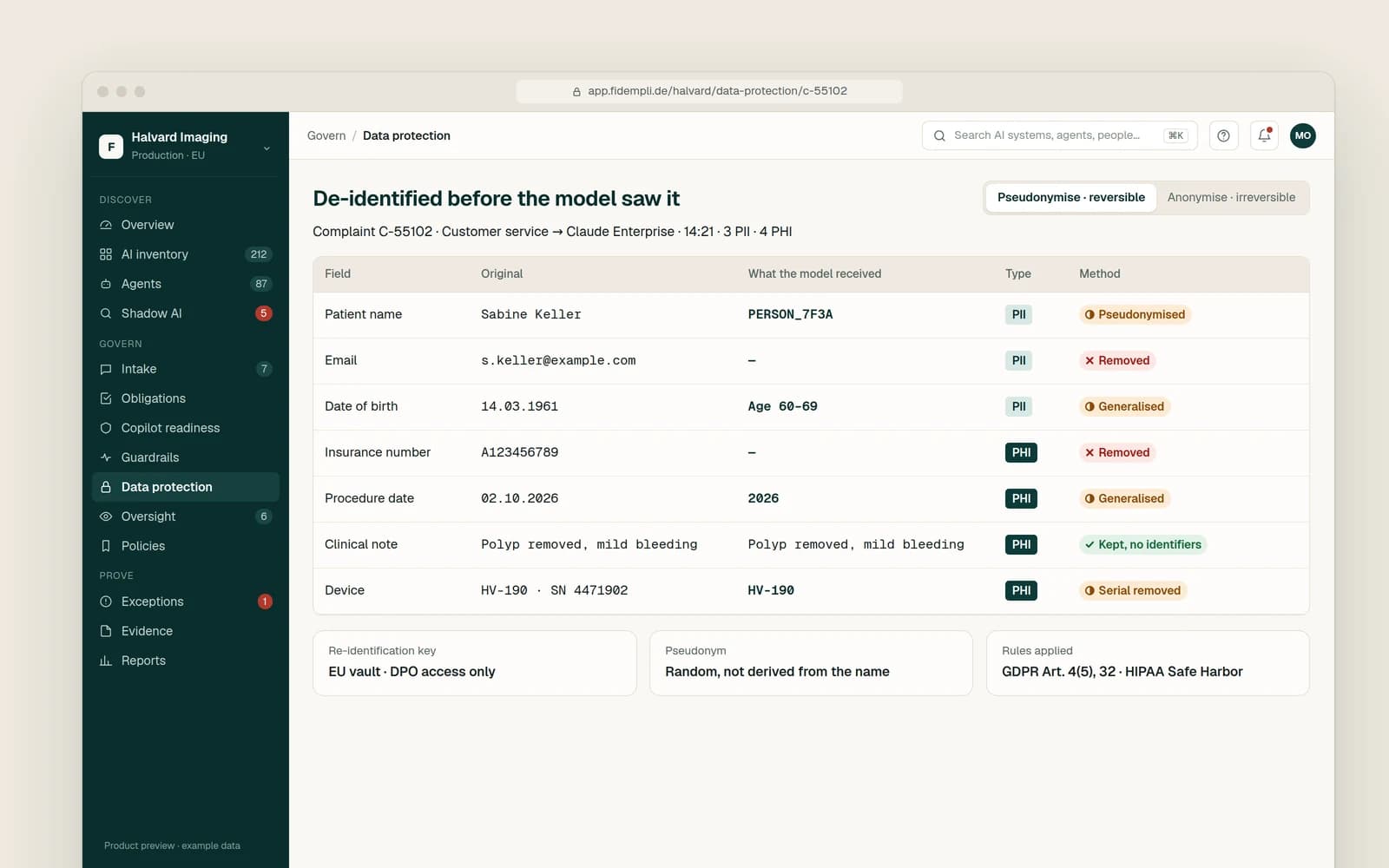
A customer complaint de-identified field by field before it was sent to an AI model
Product preview with example data

Frequently asked questions

Do we need Microsoft Purview?

Purview is the natural choice for Microsoft 365 and is included in some licences. If you use other platforms, we work with their classification and DLP tools, or a mix.

Will labelling slow our users down?

Not if the scheme is short and defaults do most of the work. We keep to a few levels, set sensible defaults and use automatic labelling where it is reliable.

Why does this matter for Copilot?

Copilot answers from data the user can already access. Overshared or unlabelled sensitive files become visible through it. Discovery, labels and permission clean-up close that gap before you switch it on.

How does this help with the GDPR?

Knowing where personal data sits supports records of processing, complete answers to access requests, deletion and retention, and security measures that fit the risk.

Can you start with one department?

Yes. We often start with one high-risk area, such as HR or finance, prove the scheme and then roll it out.

More services in this domain

Start with a 30-minute AI risk conversation.

A senior consultant replies within one business day. Or join the 3–5 design partners shaping the platform before launch.