New systems, vendors and data uses arrive faster than privacy teams can review them. Article 25 GDPR expects data protection by design and by default, and Article 35 requires a data protection impact assessment where processing is likely to result in a high risk to people.
AI adds new routes for personal data: prompts and uploads, documents indexed for retrieval (RAG), training and fine-tuning data, and logs kept by the provider. Each route is processing under GDPR, and many are not in any record.
What we do
DPIA & Privacy by Design
Map the data flows
For each system, vendor or AI use we trace which personal data is collected, where it goes, who processes it and where it is stored, including prompts, retrieval indexes, training data and logs.
Establish purpose and legal basis
We set the purpose and legal basis under Articles 5 and 6, identify special categories of data under Article 9, and check where automated decisions under Article 22 may arise.
Screen and carry out DPIAs
We screen each processing activity for the need for a DPIA under Article 35, using the supervisory authorities' lists, and carry it out where required, with risks and measures documented.
Review processors and transfers
We review data processing agreements under Article 28, the vendor's own use of your data, retention and transfers outside the EU under Chapter V.
Build in privacy by design
We turn the results into requirements for your projects and software lifecycle: minimisation, pseudonymisation, access control, default settings and retention limits under Articles 25 and 32.
Keep records current
We add each processing activity to your records under Article 30 and review DPIAs when the system, the vendor or the risk changes.
How we deliver
Consulting · Professional services · Managed services
Automated pre-fill of DPIA drafts from project, vendor and AI intake data, for the privacy team to complete and approve.
Automated detection of personal and health data in sample prompts, uploads, RAG sources and test data.
Automated generation of records of processing entries for each new system and AI use.
What you get
Data flow map per system, vendor or AI use
Legal basis and purpose per processing activity
DPIAs for the processing that needs one
Processor and transfer review
Privacy-by-design requirements for projects and software
Updated records of processing activities
Frameworks
GDPR
BDSG
EU AI Act
APPI
In detail
Topics covered
Principles, purpose and legal basis (Art. 5, 6)
Special categories of data (Art. 9)
Automated individual decisions (Art. 22)
Data protection by design and by default (Art. 25)
Processors (Art. 28)
Records of processing activities (Art. 30)
Security of processing (Art. 32)
Data protection impact assessment (Art. 35)
Transfers outside the EU (Chapter V)
AI privacy
Personal data in prompts and uploads
Retrieval (RAG) indexes and access control
Training and fine-tuning data
AI provider terms, retention and training use
Copilots and AI agents acting on personal data
Privacy by design in your software
SaaS products
Enterprise platforms
CRM
ERP
HRMS
Custom applications
Platform
After the project, the Fidempli platform keeps it running
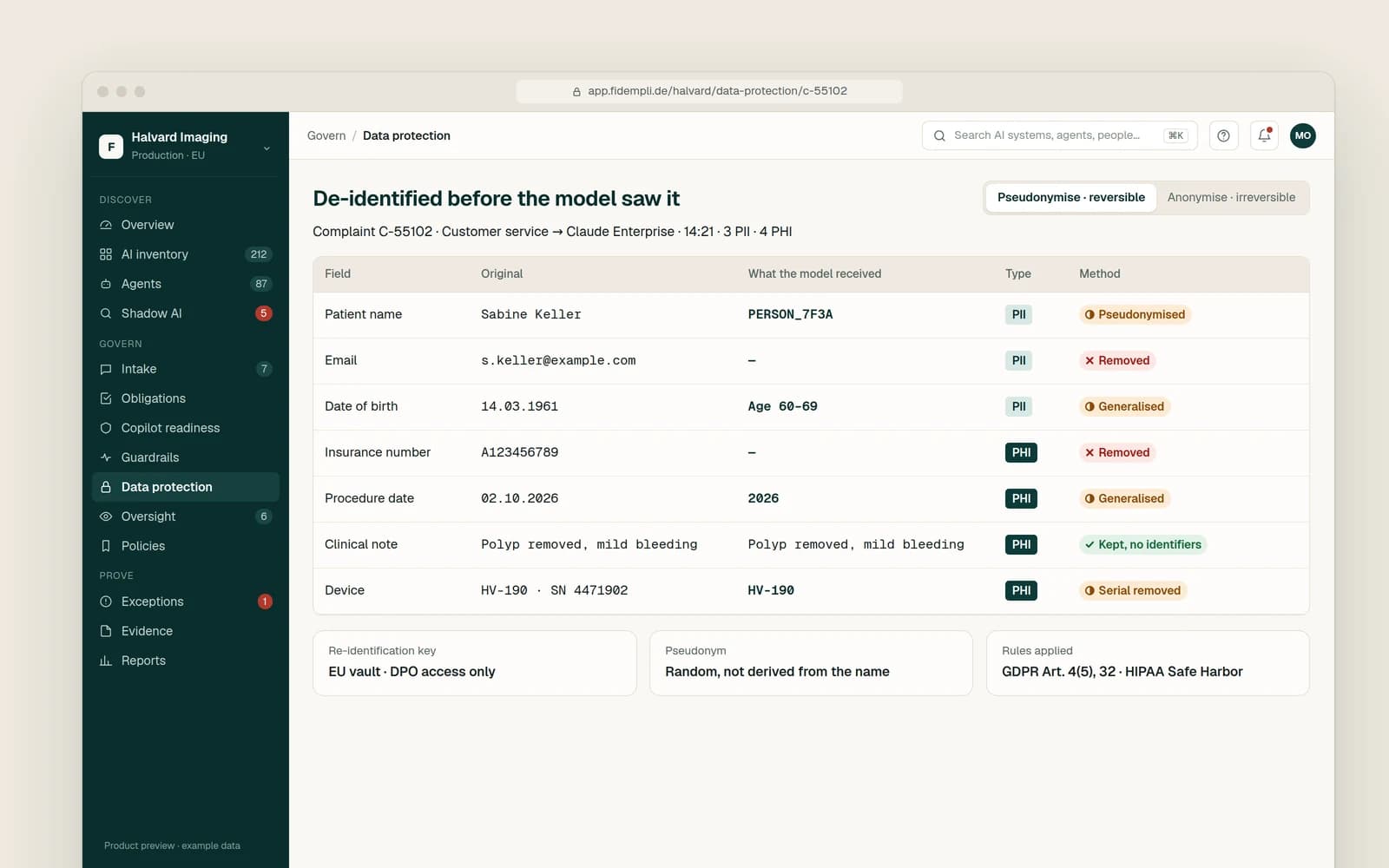
When the Fidempli platform launches in December 2026, it applies the result in daily AI use: personal and health data is pseudonymised or removed before any AI model sees it, and each DPIA stays linked to the AI system it covers.
No. Article 35 requires one where processing is likely to result in a high risk to people, for example systematic monitoring, large-scale processing of special categories or new technologies such as many AI uses. We screen each case and document the outcome either way.
Can staff put personal data into AI tools?
Only where there is a purpose, a legal basis and a provider contract that fits. We help you set clear rules per tool and add technical controls, so the rule does not depend on memory alone.
Does our AI provider use our data for training?
That depends on the product, the contract and the settings. We review the terms and configuration of each provider and record what applies.
What about personal data in RAG and training data?
Documents indexed for retrieval and data used for training or fine-tuning are processing too. We check purpose, minimisation and access control, so the AI only returns what the user is allowed to see.
We already have a data protection team. What do you add?
Capacity for DPIAs, AI-specific knowledge of how copilots, agents and RAG systems handle data, and engineers who implement the controls. Your data protection officer stays in charge of the decisions.